Deciding between a fractional CFO vs full-time CFO is one of the most consequential financial hires a growing business will make. Get it right and you gain reporting rigor, funding readiness, and margin discipline at a cost that matches your stage. Get it wrong and you either overpay for capacity you don’t need yet, or stretch a part-time relationship past the point where it can keep up with your complexity.
What a Full-Time CFO Costs and Delivers
A full-time CFO is a permanent executive hire, embedded in daily operations and typically owning the finance function end to end. For companies with revenue under roughly $50 million, base salaries commonly run from $130,000 to $200,000 a year, with bonus potential of 30-60% of base on top. Once you add benefits, payroll taxes, recruiting fees, and any equity grant, all-in annual cost for a full-time CFO at a smaller company frequently lands between $180,000 and $280,000 — and rises well past that as revenue and team size grow.
In exchange, you get someone who is available every working day, deeply embedded in your systems and team, and accountable for the finance function as their sole focus. That constant presence matters most once board meetings, daily cash decisions, or a large finance team need hands-on management every day of the week.
What a Fractional CFO Costs and Delivers
A fractional CFO works with your business for a set number of hours or days a month rather than full time, usually through a monthly retainer. Typical retainers run from about $5,000 to $10,000+ a month, or roughly $36,000 to $120,000 a year — a fraction of a full-time hire’s all-in cost, with no benefits, equity, or recruiting fees to budget for. For a full breakdown of how those retainers are typically structured, see our fractional CFO cost guide.
What you’re paying for is strategic financial leadership — cash flow forecasting, KPI reporting, fundraising support, budget discipline — without carrying the overhead of a full executive salary. Because most fractional CFOs work across several clients, you also get exposure to patterns and benchmarks from other businesses at a similar stage, something a single in-house hire can’t offer on day one.
Fractional CFO vs Full-Time CFO: The Real Cost Comparison
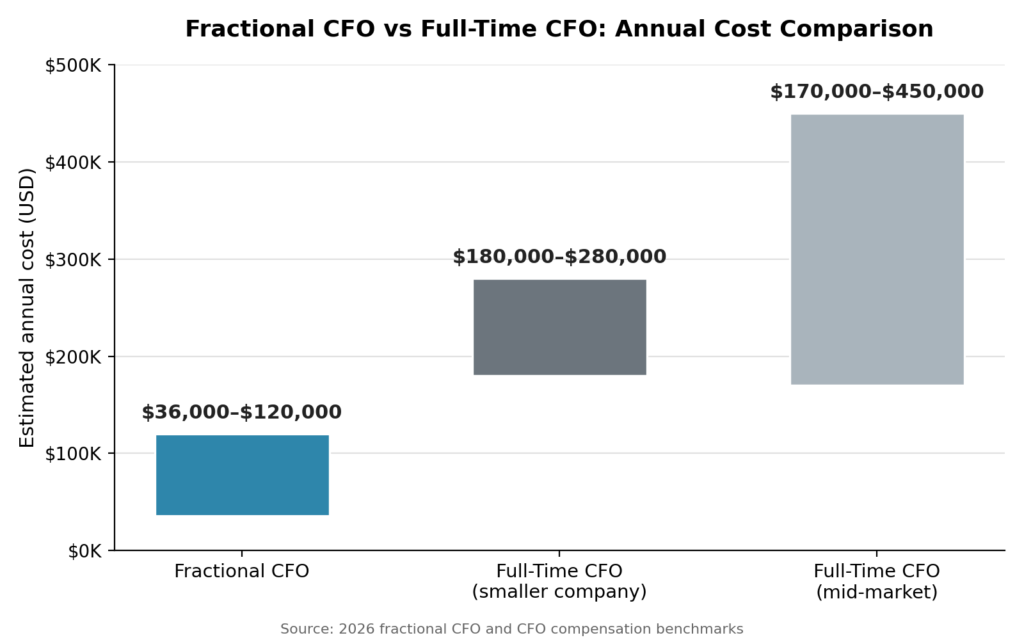
Annual cost ranges: fractional CFO vs full-time CFO.
- Fractional CFO: $5,000–$10,000+/month ($36,000–$120,000/year), no benefits or equity, scalable up or down as needs change.
- Full-time CFO (smaller company): $180,000–$280,000+ all-in annually, including base, bonus, benefits, and payroll taxes.
- Full-time CFO (mid-market, $50M–$1B revenue): Base salaries commonly $170,000–$450,000, plus bonus and equity.
The gap narrows as your fractional retainer grows. Once a fractional engagement climbs toward $10,000 a month or more and still can’t keep pace with demand, that’s usually a signal you’ve reached the point where a full-time hire pays for itself.
When a Fractional CFO Makes Sense
In the fractional CFO vs full-time CFO decision, a fractional arrangement tends to fit best when:
- Revenue is roughly in the $1M–$50M range and you need senior financial judgment without a six-figure fixed cost.
- Workload is seasonal or project-driven — a lender renewal, tax season, an acquisition, or a fundraising round.
- You’re preparing for a sale or exit two to five years out and need the numbers audit-ready without a permanent hire.
- You want to test how much value a CFO-level function adds before committing to a full-time salary.
If you’re still deciding whether you need this level of support at all, our post on the 9 signs it’s time to hire a fractional CFO is a useful gut check, and our buyer’s checklist walks through how to choose well once you’ve decided.
When a Full-Time CFO Makes Sense
Most businesses that make the switch from fractional to full-time do so somewhere between $50 million and $100 million in revenue — not earlier. Signs it’s time to hire full-time include:
- Revenue and headcount have grown to the point where the finance team needs daily, hands-on management.
- You’re on an active path to a large institutional raise or IPO, with constant board and investor reporting demands.
- Your industry requires regulatory credentials or sign-offs that call for a dedicated, always-available executive.
- Your fractional retainer has already grown past $10,000 a month and still isn’t covering everything you need.
Fast-growing SaaS companies in particular tend to hit this inflection point earlier than their revenue alone would suggest — our guide to fractional CFOs for SaaS companies covers the metrics that usually force the decision.
A Middle Path: Fractional Now, Full-Time Later
The fractional CFO vs full-time CFO choice isn’t always permanent. Many companies don’t choose one model forever — they start fractional, prove out the finance function, and convert to full-time once the workload justifies it. This is especially common for startups that need investor-grade reporting long before they can justify a six-figure executive salary. Treating the fractional engagement as a deliberate first phase, rather than a permanent placeholder, tends to produce a smoother transition when the time comes.
Questions to Ask Before You Decide
- What decisions or reporting cadences genuinely require someone in the building every day?
- How much would a bad month of cash visibility actually cost us right now?
- Is our workload steady enough to justify a fixed salary, or does it spike and fall with the season?
- If we start fractional, what specific milestone would tell us it’s time to go full-time?
- Have we priced out both options with all-in costs — not just the headline number?
Red Flags to Watch for With Either Path
Whichever way the fractional CFO vs full-time CFO decision leans for you, be wary of a full-time candidate who can’t clearly explain how they’d spend their first 90 days, or a fractional provider who is vague about how many hours a month you’re actually getting. On the full-time side, watch for compensation packages so heavy on equity that cash comfort is thin. On the fractional side, watch for a CFO spread across too many clients to give your numbers real attention.
Frequently Asked Questions
Is a fractional CFO always cheaper than a full-time CFO?
Almost always in direct dollar terms, but not necessarily in value delivered — a full-time hire can be worth the premium once your finance workload is genuinely a full-time job.
Can a fractional CFO do everything a full-time CFO does?
Mostly, yes, on a part-time schedule — the main gaps are day-to-day availability and the depth of institutional knowledge that builds up with a permanent hire.
What revenue level typically triggers a switch to full-time?
Most companies make the switch somewhere between $50 million and $100 million in revenue, though complexity and fundraising activity can push that earlier.
Can we run a hybrid model with both?
Yes — some businesses keep a fractional CFO for strategy while building an internal controller or finance manager for day-to-day execution, then convert fully later.
How do we compare all-in costs fairly?
Add salary, bonus, benefits, payroll taxes, and any equity for the full-time option, and compare that total against the fractional retainer plus any tools or software you’d need either way.
The Bottom Line
The fractional CFO vs full-time CFO decision comes down to workload, complexity, and budget — not prestige. Smaller and mid-stage businesses are almost always better served starting fractional and scaling up only when the numbers force the issue. As compensation research on CFO pay by company size shows, full-time costs climb sharply with scale — so it pays to size the decision to where your business is today, not where you hope it will be next year.

My Name is Nadeem Shaikh the founder of nadeemacademy.com. I am a Qualified Chartered Accountant equivalent US CPA , Bachelor in Commerce and Masters in Commerce. having professional and specialize Knowledge and experience in field of Account, Finance, and Taxation. Total experience of 20 years in providing businesses solution in Taxation, Accounting, and Finance with all statutory compliance with timely business performance Financials reports. You can contact me on info@nadeemacademy.com.