
Deciding to hire a fractional CFO is usually the easy part. The harder question most founders and business owners have is what happens next — what do the first weeks actually look like, what will you be asked for, and how quickly will you see something useful for the effort? This post walks through our full fractional CFO onboarding process end to end, so you know exactly what to expect before you ever sign an engagement letter. (Still comparing providers or deciding whether to hire at all? Our step-by-step hiring guide is the right starting point instead.)
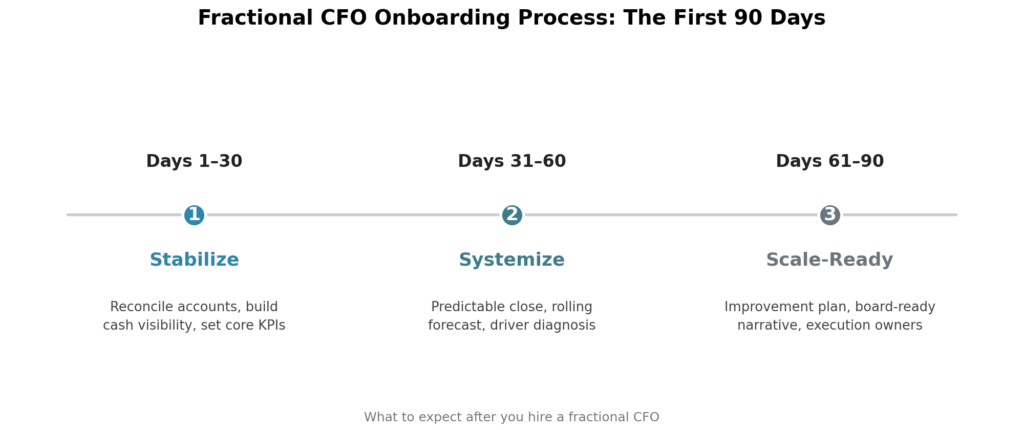
What to expect in the first 90 days after you hire a fractional CFO.
What “Hiring a Fractional CFO” Actually Means Today
Different business owners search for this same service under different names — fractional CFO services, an outsourced CFO consultant, a virtual CFO for small business, or simply part-time CFO services. They all describe the same core idea: senior financial leadership, delivered on a flexible schedule and at a fraction of a full-time executive salary, rather than a traditional in-house hire. Some clients want a hands-on partner for board reporting and fundraising; others mainly want someone to make monthly numbers trustworthy and predictable. Our onboarding process is built to surface which of those you actually need before any work begins, rather than assuming a one-size-fits-all engagement.
What’s Included in Fractional CFO Services
Because the title covers so much ground, it helps to be concrete about what’s actually included. Most fractional CFO services engagements combine some mix of the following, scaled to the size of the business:
- Monthly or weekly financial statements — P&L, balance sheet, and cash flow — reviewed in plain language, not just delivered as a file
- Cash flow forecasting and runway tracking, so surprises get caught weeks in advance rather than the day they happen
- KPI and board-level reporting, built around the four or five numbers that actually drive the business
- Budgeting, variance analysis, and rolling forecasts tied to real decisions like hiring or pricing changes
- Fundraising support — financial models, investor materials, and due diligence preparation
- Vendor, banking, and lender relationship management
Not every client needs all of it on day one. Part of onboarding is agreeing on which of these matter most right now, and which can be layered in later as the business grows.
Who This Fractional CFO Onboarding Process Is Built For
We work with small businesses that have outgrown a bookkeeper but aren’t ready for a full-time executive, with venture-backed startups that need investor-grade reporting, and with established B2B fractional CFO services clients — manufacturers, agencies, and professional services firms — who need corporate-level financial strategy without adding permanent headcount. If you’re running an ecommerce brand, a SaaS company, or an agency, the same core onboarding steps apply, just with different KPIs front and center: inventory and gross margin for ecommerce, MRR and churn for SaaS, utilization and project profitability for agencies. Startups in particular tend to have their own timeline for this decision — see our take on fractional CFOs for startups if that’s your situation. If you haven’t yet decided this is the right move, our 9 signs it’s time to hire a fractional CFO is a useful gut check before you get here.
Before You Hire: What to Prepare
The single biggest factor in how fast an engagement gets useful is how quickly we can see accurate numbers. Before your first working session, we’ll ask for:
- Read-only access to your accounting platform (QuickBooks, Xero, NetSuite, or similar)
- 12–24 months of financial statements, if available
- Recent bank and credit card statements
- Payroll and contractor payment reports
- Accounts receivable and accounts payable aging reports
- Any debt schedules, lease obligations, or cap table details
- Pricing, product/service mix, and (if relevant) sales pipeline visibility
None of this needs to be perfectly organized. Part of what you’re paying for is someone who can make sense of imperfect books — the goal here is just to get us looking at the same information you are.
Step 1: Discovery Call and Fit Assessment
Every engagement starts with a conversation, not a contract. We talk through where the business is today, what’s keeping you up at night financially, and what “success” would look like in three, six, and twelve months. This is also where we scope which flavor of the role you need — a lean part-time CFO services arrangement focused on monthly reporting, or a deeper outsourced CFO consultant relationship that includes fundraising support, board materials, and strategic planning. If the fit isn’t right, we’ll tell you — including pointing you toward a bookkeeper or controller if that’s genuinely what you need instead.
Step 2: The Financial and Systems Audit (Days 1–30)
Once you’re onboard, the first 30 days are about making your numbers trustworthy. We reconcile accounts, standardize how expenses and revenue are categorized, and verify that what your books say matches reality. From there we build a simple weekly cash rhythm, following cash flow management practices recommended by SCORE, so upcoming obligations stop being a surprise, and define a small starter set of KPIs — usually gross margin, sales efficiency, overhead health, and cash runway — that will anchor every conversation going forward. By day 30, most clients tell us the same thing: they trust the direction of the numbers more than they did a month earlier, and cash feels less like guesswork.
Step 3: Engagement Scope and Pricing Package
As part of the fractional CFO onboarding process, around this point we finalize the ongoing engagement scope and cadence — how many hours or days a month, which deliverables, and at what price point. Packages typically range from a lean, cash-flow-focused retainer up to a full board-reporting and strategic-advisory package, and we’ll walk you through exactly what’s included at each tier before you commit to anything. If budget is the main question on your mind right now, our fractional CFO cost guide breaks down typical monthly retainer ranges in detail, and our fractional CFO vs. full-time CFO comparison is worth a look if you’re still weighing that decision against an in-house hire. If you only need short, defined-scope coverage — closing out a fundraise or covering a leadership gap for a few months — we can also structure this as interim support billed at an hourly or project rate rather than a standing monthly retainer, and we’ll flag upfront whether that’s a more affordable fit than an ongoing engagement.
Questions Worth Asking Before You Sign
Whoever you ultimately hire, a few questions tend to separate a good fit from a frustrating one:
- Who exactly will be doing the work each month, and is that the same person you’re talking to now?
- What’s included in the base engagement, and what triggers an extra fee?
- How is progress reviewed — a recurring call, a written report, both?
- What does a typical 30-day, 60-day, and 90-day milestone look like for a business like mine?
- What happens if my needs shrink or grow significantly six months in?
If a prospective provider can’t answer these clearly and specifically, that’s usually worth treating as a red flag on its own.
Step 4: Building Cadence and Forecasting (Days 31–60)
With trustworthy numbers in place, the next stretch is about turning them into a repeatable rhythm. We establish a predictable monthly close timeline and a standing performance review meeting, then build a rolling forecast that links real assumptions — headcount plans, pricing changes, utilization — to actual outcomes rather than static year-old projections. We also start diagnosing performance by driver rather than by gut feel: delivery economics first, then growth efficiency, then overhead structure. By day 60, closing the books stops being a fire drill and forecasts start actively shaping decisions instead of just documenting the past.
Step 5: Scale-Ready Execution (Days 61–90)
The final stretch of onboarding is where strategy turns into momentum. We deliver a diagnostic summary of the biggest gaps and opportunities we’ve found, translate the numbers into a financial narrative your leadership team can actually repeat in a board meeting or investor update, and build a focused improvement plan with clear owners and outcomes. For companies actively preparing to raise capital, this is also when financial models and data-room materials typically come together. By day 90, you should have reliable numbers, a predictable finance cadence, real cash visibility, and a concrete plan the leadership team is already executing against — not just a slide deck that gets filed away.
What Happens After Day 90
The fractional CFO onboarding process has an end date; the partnership doesn’t. Most clients settle into a standing monthly or quarterly cadence from here — closing the books, reviewing KPIs, updating the forecast, and flagging issues before they become emergencies. Because this is remote CFO advisory work by design, most of this happens over video calls and shared dashboards rather than in-person meetings, which is exactly why it fits distributed and multi-location teams so well. The relationship should feel less like a vendor check-in and more like having a finance executive who happens to work part-time.
When to Start This Process Sooner Rather Than Later
While plenty of clients bring us in proactively, just as many reach out because something specific is happening in the business right now. A handful of situations tend to compress this timeline considerably:
- You’re heading into a fundraise and need financial models, pitch deck numbers, and diligence materials ready on a tight clock.
- Cash flow has gotten tight despite healthy-looking revenue, and you need a clear-eyed cash management plan fast.
- The business needs financial restructuring — renegotiated debt, a leaner cost structure, or a turnaround plan — and waiting isn’t an option.
- You’re scaling across a distributed team and need board-level financial advisory without adding a full-time seat.
In any of these cases, tell us upfront — we’ll compress the standard 90-day arc into a faster path focused on the most urgent problem first, while still building toward the same long-term financial foundation.
Frequently Asked Questions
How long does it take to hire a fractional CFO and get started?
Most engagements move from first conversation to signed scope within one to two weeks — the fractional CFO onboarding process moves fast, and meaningful work such as reconciling accounts and building cash visibility starts in the first session.
Do I need clean books before I hire a fractional CFO?
No. Cleaning up and making sense of imperfect books is part of the first 30 days, not a prerequisite for starting.
Is this different from hiring an outsourced CFO consultant for a single project?
It can be structured either way. Some clients want an ongoing part-time relationship; others bring us in for a defined project like a fundraise or restructuring and scale down afterward.
Do you work with industries outside of general small business, like ecommerce, SaaS, or agencies?
Yes — the onboarding process is the same, but the KPIs we prioritize shift by industry: inventory and margin for ecommerce, MRR and churn for SaaS, utilization and project profitability for agencies.
What if we decide it’s not the right fit after onboarding starts?
The discovery call is designed to catch most mismatches before they happen, but engagements are scoped month to month rather than locked into long contracts, specifically so either side can adjust.
Is there an affordable option if we’re an early-stage or bootstrapped business?
Yes. Engagement scope, hours, and deliverables all flex to budget — an early-stage company might start with a narrow cash-flow-only package and expand as revenue grows, rather than paying for board-level reporting it doesn’t need yet.
Can we start with an interim CFO on an hourly basis instead of a full retainer?
Yes. Short-term or project-based needs — covering a leadership gap, closing out a fundraise, or getting through a specific deadline — can be billed hourly rather than as an ongoing monthly engagement.
The Bottom Line
Deciding to hire a fractional CFO is a decision most business owners only make once they’re already stretched thin — which is exactly why the fractional CFO onboarding process matters so much. A good first 90 days should leave you with trustworthy numbers, a predictable finance cadence, and a concrete plan, not just a new name on your org chart. If you’re ready to see what that looks like for your business, or still comparing this option against a full-time hire or a standard buyer’s checklist approach, we’re happy to start with a no-pressure discovery call.

My Name is Nadeem Shaikh the founder of nadeemacademy.com. I am a Qualified Chartered Accountant equivalent US CPA , Bachelor in Commerce and Masters in Commerce. having professional and specialize Knowledge and experience in field of Account, Finance, and Taxation. Total experience of 20 years in providing businesses solution in Taxation, Accounting, and Finance with all statutory compliance with timely business performance Financials reports. You can contact me on contact@nadeemacademy.com.